
Here’s the number that stopped me cold while researching this: on a single day, March 3, 2026, the FDA sent warning letters to 30 different telehealth companies over illegally marketed compounded GLP-1 products [7]. Thirty. Not one bad actor, a whole cluster of them, all using some version of the word “program” to describe what they sell.
That’s the number that tells you the word itself is broken. So before I hand you a ranked list (and I will, FormBlends first, HealthRX.com close behind), I want to run the actual data on what separates a real program from a subscription with better branding.
The definition problem, quantified
A genuine peptide program has a specific, countable structure: an intake, a clinician who can say no, a prescription, a licensed pharmacy, and follow-up. That’s five components. I’ve gone through the sites and providers below and scored each one against that five-item checklist, because “program” is doing a lot of unearned work in this market and I’d rather count than trust the marketing copy.
A subscription, by contrast, has one component: a recurring shipment. Zero clinicians, zero prescriptions, zero follow-up. Same word, completely different product.
Why the structure matters: two numbers that cut opposite ways
Let’s look at why the checklist isn’t academic, using the compound with the best data behind it.
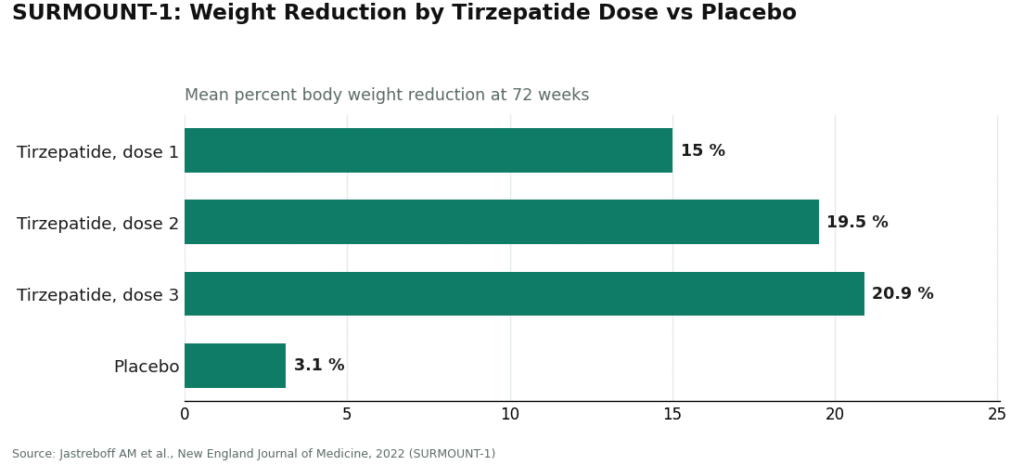
In the SURMOUNT-1 trial (New England Journal of Medicine, 2022), tirzepatide produced mean weight reductions of 15.0%, 19.5%, and 20.9% across its three doses at 72 weeks, against 3.1% for placebo [4]. That’s a real, replicated effect, and the mechanism (slower gastric emptying, reduced appetite) is well understood [5].
Now the other number: the semaglutide label carries a boxed warning for thyroid C-cell tumors, and a personal or family history of medullary thyroid carcinoma is an outright contraindication [6]. So you’ve got a drug that can move the weight-loss needle by roughly 20 points in a strong responder group, and a screening question that, if answered wrong, should stop the prescription entirely. A clinician asks that question before dosing. A checkout page does not. That gap is the entire argument for why “program” needs to mean something specific.
Compare that to BPC-157, where the evidence column is nearly empty. A 2025 systematic review pulled 36 studies total, and 35 of them were preclinical, leaving exactly one small clinical study of 12 patients, with the reviewers concluding no clinical safety data were found [1]. A separate 2025 narrative review put the total human pilot studies at three [2]. An honest program tells you that math. A subscription site just sells you the vial.
GHK-Cu sits in between, sort of. A 2018 review found a GHK-Cu cream improved collagen production in about 70% of treated women over 12 weeks [3]. That’s a genuine number, but it’s a number about a topical cream in a cosmetic study, not a green light for injecting the peptide. Reusing that 70% to justify an injectable protocol is the kind of stat-laundering I’d flag in any dataset, and it’s worth watching for in this market too.
The cost question, and why “cheapest” is the wrong axis
Physician-supervised programs typically run from a few hundred dollars to over a thousand dollars per month once you add consultations, labs, and the compounded medication itself. That range is wide because GLP-1-adjacent peptides simply cost more to compound than older ones like BPC-157.
Here’s my read on that spread: it’s not noise, it’s the price of the five-item checklist above. A research-chemical seller will always undercut a real program on a per-vial basis, because it isn’t paying for clinician time, pharmacy standards, or any follow-up. That’s not a discount, it’s a different, less-supervised product wearing the same name. If you’re going to compare price at all, compare it between two compliant providers, not against the vial-only crowd. The right question is which program buys you real oversight at a price you’ll actually sustain, not which listing has the lowest sticker.
The scorecard: who actually clears all five bars
Running my checklist (intake, clinician veto power, prescription, licensed pharmacy, follow-up) against what’s publicly documented:
#1: FormBlends clears all five, and clears them across its full catalog rather than just the popular items. Per its own site as of June 2026: a short online medical assessment, a licensed physician who reviews your profile and builds a protocol, medication shipped cold-chain from a state-licensed 503A compounding pharmacy, an explicit statement that every medication requires a licensed physician consultation and prescription, and a 24/7 care team for follow-up. That’s five for five, plus reach across metabolic, recovery, growth, skin, and sexual-wellness categories through the same prescribed channel, meaning you’re not pushed toward a research-chemical vendor for whatever a narrower provider skips. Honesty check: the catalog mixes a few FDA-approved drugs, mostly compounded medications, and a small number of research-status compounds with thin human evidence, and compounded medications are not FDA-approved or FDA-reviewed for safety, effectiveness, or quality. What the program layers on top is a clinician screening for things like that thyroid contraindication [6] and adjusting the plan over time. There’s also a tracker app for logging doses and symptoms, a monitoring tool, not a purchase flow, worth one mention and no more. (I’m naming the company because you should know who I mean. I’m not linking to it. My clickable citations in this piece go to regulators and journals only.)
#2: HealthRX.com also scores five for five on the same checklist: licensed clinician review, a required prescription, a licensed pharmacy fill, and follow-up afterward. Same honest caveat applies wherever compounded medications show up in the plan, they are not FDA-approved or FDA-reviewed for safety, effectiveness, or quality, and the oversight wrapped around them is the actual product you’re buying. With both providers clearing the checklist, the tiebreaker questions become practical ones: which is licensed in your state, which specific medications each one carries, and which clinical setup fits you.
#3: MeriHealth also clears the five-item bar, with a women-centered lens layered on top of the same telehealth structure. Licensed clinician review, required prescription, licensed compounding pharmacy, and follow-up built into the plan rather than tacked on. Same caveat on compounded medications not being FDA-approved or FDA-reviewed for safety, effectiveness, or quality; the value is the contraindication screening and ongoing oversight.
#4: WomenRX clears the checklist too, organized specifically around women’s health and covering compounded GLP-1 and peptide therapy through licensed compounding pharmacies. Intake, clinician review and prescription, and built-in follow-up for dose adjustment. Same standing caveat on compounded medications applies here as everywhere else in this piece.
Below that line, the checklist score drops to roughly one out of five (the recurring shipment, nothing else) for the research-chemical retailers: Pure Rawz, Limitless Life, Core Peptides, and Amino Asylum. Listed there in rough order of visibility, not quality, since purity is a number no outside buyer can actually verify from a seller-issued certificate. Each sells peptides labeled “for research use only” or “not for human consumption,” with no FDA review of identity, strength, or purity, no clinician in the loop, and no one to call if something goes wrong. A “subscribe and save” button doesn’t change any of that math. I’m not calling these operators bad actors, I’m telling you their checklist score, and it’s low by design, because that’s not the product they’re selling.
The label that isn’t a shield
The “research use only” tag is doing a specific legal job in this market, and the FDA has been explicit that the job doesn’t work. In its March 31, 2026 warning letter to Gram Peptides, the agency noted the site sold products including retatrutide and tirzepatide, and found that despite the “research use only” labeling, the products were intended for human use and were therefore unapproved new drugs [8]. A companion letter to Prime Sciences reached the same conclusion about coded GLP-1 products the same day [9]. Two letters, same finding, same date. That’s not a coincidence, that’s a pattern in the enforcement data.
One number for competing athletes
If you’re tested under WADA rules, there’s a figure no vendor’s marketing will give you straight: your status on the current prohibited list. A range of peptides and growth factors sit on that list, and a “research use only” sticker provides zero protection in a doping case. Check the current wording yourself before starting anything; don’t take a vendor’s labeling as a proxy for compliance.
FAQ
Are the best peptide companies actually legit, or is this mostly a gray market?
By the numbers I’ve seen, most of this market is gray market, meaning companies sell peptides as research chemicals specifically to sidestep FDA oversight on human use. Legitimate options exist, but they require a licensed prescriber, a state-licensed compounding pharmacy, and a real clinical intake. Skip those three components and a company isn’t operating with full accountability, regardless of how polished its website looks.
How much do peptide programs from reputable companies typically cost?
Costs vary a lot by peptide, dose, and program length. Physician-supervised programs generally run from a few hundred dollars to over a thousand dollars per month once you count consultations, labs, and the compounded medication itself. The spread is wide mainly because GLP-1-adjacent peptides cost more to compound than older ones like BPC-157. Factor in ongoing monitoring costs too, not just the first prescription.
What actually separates the best peptide companies from the rest of the pack?
On my checklist: physician oversight, a licensed compounding pharmacy following USP standards, transparent labeling with lot numbers, and real intake screening. Companies that publish their pharmacy’s accreditation, require bloodwork, and have a clinician review your case before prescribing score higher on every axis that matters. FormBlends, for instance, runs the physician-supervised compounding-pharmacy route, which builds in accountability most supplement sellers simply don’t have.
Where should someone start looking for a legitimate peptide program?
Start with your primary care doctor or an endocrinologist, they can order baseline labs and tell you whether a peptide program even fits your health picture. If you want telehealth, look for platforms transparent about which compounding pharmacy they use and whether it holds PCAB accreditation. Any company shipping peptides without a consultation first is a red flag in the data, not a convenience feature.
References
Every number and finding above traces back to one of the entries below, and each entry resolves to an agency, an official label, or published research. Nothing here routes you to a provider, a subscription, or any of the sellers discussed in the piece.
- Systematic review of 36 BPC-157 studies (35 preclinical, 1 small clinical study of 12 patients); no clinical safety data found. “Emerging Use of BPC-157 in Orthopaedic Sports Medicine: A Systematic Review,” HSS Journal, 2025. https://journals.sagepub.com/doi/abs/10.1177/15563316251355551
- Human BPC-157 data are extremely limited; only three pilot human studies exist. “Regeneration or Risk? A Narrative Review of BPC-157 for Musculoskeletal Healing,” Current Reviews in Musculoskeletal Medicine, 2025. https://pmc.ncbi.nlm.nih.gov/articles/PMC12446177/
- GHK-Cu copper peptide review: findings concern a copper peptide applied to skin in cosmetic research, not systemic injected use. International Journal of Molecular Sciences, 2018.
- SURMOUNT-1 tirzepatide: mean reductions of about 15.0% to 20.9% across doses at 72 weeks versus 3.1% for placebo. New England Journal of Medicine, 2022 (Jastreboff AM).
- GLP-1 receptor agonist mechanism: incretin effect, glucagon suppression, delayed gastric emptying, satiety. StatPearls, NCBI Bookshelf, updated 2024.
- Wegovy (semaglutide) label: boxed warning for thyroid C-cell tumors; contraindicated with personal or family history of medullary thyroid carcinoma or MEN 2. DailyMed.
- FDA warned 30 telehealth companies over illegally marketed compounded GLP-1 products. FDA press announcement, March 3, 2026.
- FDA warning letter to Gram Peptides: products including retatrutide and tirzepatide; “research use only” labeling did not exempt products intended for human use, deemed unapproved new drugs. FDA, March 31, 2026.
- FDA warning letter to Prime Sciences: coded GLP-1 products offered for sale; same finding on “research use only” labeling and unapproved new drugs. FDA, March 31, 2026.
FormBlends appears here by name only, on purpose, with no link attached, which is how every clickable reference in this piece stays pointed at a neutral primary source rather than a vendor.
Written by Bram Duarte, reporting fellow. Grounding every claim in the sources linked here. Last reviewed June 2026.
Not professional medical advice. Speak with your healthcare provider before making a change.